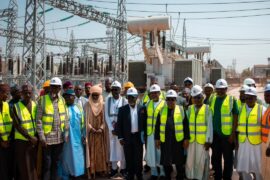

Minister of State for Petroleum Resources (Oil), Senator Heineken Lokpobiri, has commended the leading engineering construction company, Julius Berger Nigeria PLC, for the quality of work on the Oloibiri Museum and Research Centre (OMRC), describing the landmark facility as “a masterpiece” and reaffirming the Federal Government’s commitment to completing the project by 2028.
Lokpobiri who defied the rainfall during his inspection of the ongoing project in Otuabagi, Ogbia Local Government Area of Bayelsa State, where commercial oil production began in Nigeria in 1956, said he was impressed with the pace of construction, adding that the facility would preserve the history of Nigeria’s petroleum industry while serving as a major centre for research, tourism and industry events.
“I am very happy that I came today to see what is going on here. This is a masterpiece. The main building itself is over 10,000 square metres,” the minister said, noting that the museum and research centre would provide Nigerians and international visitors with a better understanding of the origins and evolution of the nation’s oil and gas industry, including its achievements, challenges and prospects. The facility, he further said, will also create opportunities for conferences, exhibitions, retreats and research activities in the petroleum sector, even as he praised the quality of the work done so far and Julius Berger’s pace of work at the site.
The minister also emphasised that the Federal Government will continue to give financial support to the project to ensure seamless execution while pledging to maintain close oversight of the project through regular visits, including unscheduled inspections, and praised Julius Berger for the quality of work completed so far, just as he appealed to the host community to sustain their cooperation with the contractors and other stakeholders to guarantee the successful delivery of the project.
Speaking on behalf of the contractor, the Project Manager, Engr. Botha de Bruyn, reaffirmed the company’s commitment to delivering the project in line with approved specifications and timelines.
He said Julius Berger recognised the historical significance of the facility and would continue to work closely with the Federal Government, the project management team and the host community to ensure its successful completion.
De Bruyn also reiterated the company’s commitment to maintaining the highest standards of quality, safety and professionalism throughout the construction process.
Providing an update on the development, the Project Director of the Oloibiri Museum and Research Centre, Architect Ladipo Lewis, said the project was conceived to recognise Otuabagi as the birthplace of Nigeria’s petroleum industry.
He explained that the facility would document and preserve the history, culture, environment and technological evolution of the oil and gas sector, while also serving as a hub for research, training and knowledge sharing.
Lewis disclosed that the project had attained over15 per cent completion, with significant infrastructure works already executed.
According to him, more than 580 foundation piles have been completed to depths exceeding 17 metres, while the concrete foundation slab for the main museum building has been fully cast. He added that structural works were advancing steadily, with columns already rising to support the mezzanine and upper floors of the museum complex.
The project director further revealed that Oil Wells 1 and 2 had reached roofing level, while the Centre’s accommodation facility, health centre, perimeter fencing and other ancillary structures were progressing as scheduled. Lewis said the main museum building would cover more than 10,500 square metres, including over 4,000 square metres of gallery space, a large lobby and a modern auditorium, while the research centre and laboratories would occupy more than 5,400 square metres.
Beyond preserving Nigeria’s oil heritage, he said the project was expected to stimulate tourism and economic activities in Oloibiri and surrounding communities through investments in hospitality, conferences and related services. He also highlighted the area’s ecological and cultural assets, noting that the completed facility could attract researchers, tourists, conservation groups and documentary producers from across the world.
“This is an opportunity to engage the entire world and put Oloibiri on the map of the world,” Lewis said.
When completed in 2028, the Oloibiri Museum and Research Centre is expected to become one of Nigeria’s premier heritage and research destinations, preserving the story of the country’s petroleum industry while contributing to tourism, education and economic development in the Niger Delta.
The Oloibiri Museum and Research Centre is being developed at the site where commercial oil exploration began in Nigeria in 1956. Designed as a national heritage, research and tourism hub, the facility will document and preserve the history of Nigeria’s oil and gas industry while serving as a centre for education, research, exhibitions and conferences.
Representatives of the company at the landmark event include: the Managing Director, Engr. Dr. Peer Lubasch, Deputy Regional Manager, South and East, Engr. Rimon Marisho, Regional Manager, Administration, Chief Sam Ngbor, Board Officer, Mrs Cynthia Ikpi and Project Manager, Engr. Botha De Bruyn