
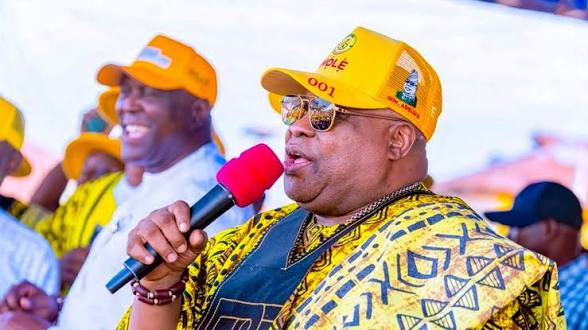
The National Forum of Former Legislators (NFFL) has approached the Supreme Court to challenge the recent Court of Appeal judgment that halted the deregistration of Accord Party and four other political parties.
The legal action has reopened uncertainty over the future of Accord, African Democratic Congress (ADC), Action Peoples Party (APP), Zenith Labour Party (ZLP) and Action Alliance (AA), whose continued participation in Nigeria’s electoral process is now subject to a final determination by the apex court.
In court documents filed in Abuja and sighted by our reporter, the NFFL urged the Supreme Court to set aside the Court of Appeal judgment and restore the earlier decision of the lower court directing the deregistration of the five political parties.
The Forum’s case is largely anchored on Section 225A of the Nigerian Constitution, with the former lawmakers arguing that the affected parties failed to satisfy the constitutional requirements for continued recognition as political parties.
A senior member of the Forum, who spoke on condition of anonymity because he was not authorised to comment publicly on the pending litigation, said the decision to approach the Supreme Court was aimed at obtaining a definitive interpretation of the constitutional provision.
“There is a pressing need to bring this matter to a logical, definitive conclusion, having already passed through the crucibles of both the High Court and the Court of Appeal,” the source said.
According to him, the objective of the suit is to clarify the interpretation of Section 225A and establish a clear legal framework for political parties and electoral stakeholders.
The case has so far produced conflicting decisions at the lower courts.
While the High Court ruled in favour of deregistering the five parties, the Court of Appeal subsequently overturned the decision, giving the affected political parties a reprieve.
The Supreme Court will now have the final say on the dispute.
The legal battle has also generated concern among supporters and voters associated with the affected parties, particularly as preparations for future elections intensify.
A resident of Osogbo, who spoke on condition of anonymity, said the conflicting judgments had created uncertainty for voters who might identify with candidates contesting under any of the affected parties.
“Anything can happen at this final stage at the Supreme Court, and it is making us very uneasy,” the resident said.
The resident expressed concern that voters could cast their ballots for candidates under one of the affected platforms only for the party’s legal status to subsequently be invalidated.
The Supreme Court is expected to determine the next steps in the case, including the scheduling of proceedings.
Beyond the immediate fate of Accord, ADC, APP, ZLP and AA, the outcome could have wider implications for Nigeria’s electoral jurisprudence, particularly the interpretation of constitutional requirements governing the registration and continued existence of political parties.
Until the Supreme Court delivers its final judgment, the five parties remain in a state of legal uncertainty over their future participation in Nigeria’s electoral process.